— 01 — POV
Most marketing is off-brand. Ours isn't.
OnBrand is an independent, AI-driven, full-funnel marketing agency — built for the MENA market, bilingual by design, single-operator by choice. This document is the source of truth for how the brand looks, sounds, and shows up.
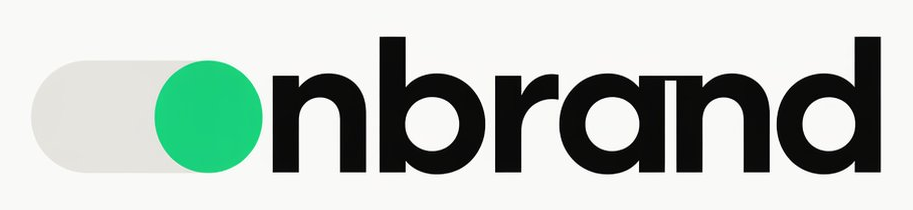
The OnBrand wordmark is one continuous idea: an iOS-style toggle, fixed permanently in the active state. The lowercase o in onbrand is the toggle knob. The track behind it shows the switch has just been flipped. The mark literally does what the brand promises.
The Arabic mark preserves the meaning by changing the construction. In «أون» — the loanword for on — the toggle stands alone as the entire word, followed by «براند». The toggle's knob sits on the left, because in right-to-left reading, that's the active end. The mark adapts to the reader, not the other way around.
The knob never sits at the OFF end. The brand has no off state — that would undo the joke and the promise.
The mark is solid forms only. Outlined or stroked versions weaken the visual weight and read as juvenile.
On all four sides of the wordmark. This is the minimum — more is fine, less is never.
The knob's color is the brand's single signal. Charcoal knob, neutral knob, gradient knob — all dead.
Inter carries the Latin script — it's confident, geometric, and works at every size from 11px caption to 96px hero. IBM Plex Sans Arabic carries Arabic with the same proportions and tone, so bilingual moments don't feel like translations. JetBrains Mono carries the AI-native voice — section labels, code, data, numbered moments. Three typefaces, all free, all open-source.
Ink on Bone is the entire brand 90% of the time. Live Green is the single accent — used only where the eye needs to land: the toggle knob, the active state, a single CTA, a section number. The moment Live Green stops being scarce, it stops being a signal.
Track and Whisper exist as supporting tones — they never count toward the dominant ratio. If a layout has more than 8% Live Green by area, it's overusing the accent.
The OnBrand voice doesn't sell, doesn't pitch, doesn't perform. It states. Where other agencies write headlines, OnBrand writes sentences. Where others use adjectives, OnBrand uses nouns. The voice should sound like a senior strategist who's seen enough work to know what's actually going to land — and is giving you the version without the deck.
If a sentence has two ideas, split it. The brand doesn't stack adjectives or string promises — it states one thing at a time, clearly.
Not "best results" — "47% lower CAC in 90 days." Not "amazing strategy" — "the strategy your competitor isn't running." Numbers and named outcomes always.
Arabic copy is rewritten — never word-for-word from English. A sharp English line becomes a different sharp Arabic line. Both should feel like the original.
No "we craft journeys," no "synergistic activations," no "best-in-class solutions." If a phrase could appear on any agency website, it can't appear on OnBrand's.
Every multi-section deliverable — landing pages, decks, proposals, case studies — uses the same layout primitive: a numbered section label in JetBrains Mono, an Inter heading below, and a one-line subhead before the content begins. Sections are separated by 96px of vertical space (or 64px on dense pages). Bullets are rare. Prose carries the work.
OnBrand engagements are scoped by outcome, not hours. We agree on what success looks like, work toward it for 30/60/90 days, and you keep what we built — strategy, content, ad accounts, automations, attribution. No vendor lock-in, no monthly retainers that drift, no team to keep busy.
How the brand shows up across the surfaces that matter most for a solo agency: business card, social avatar, deck title, email signature, social post.